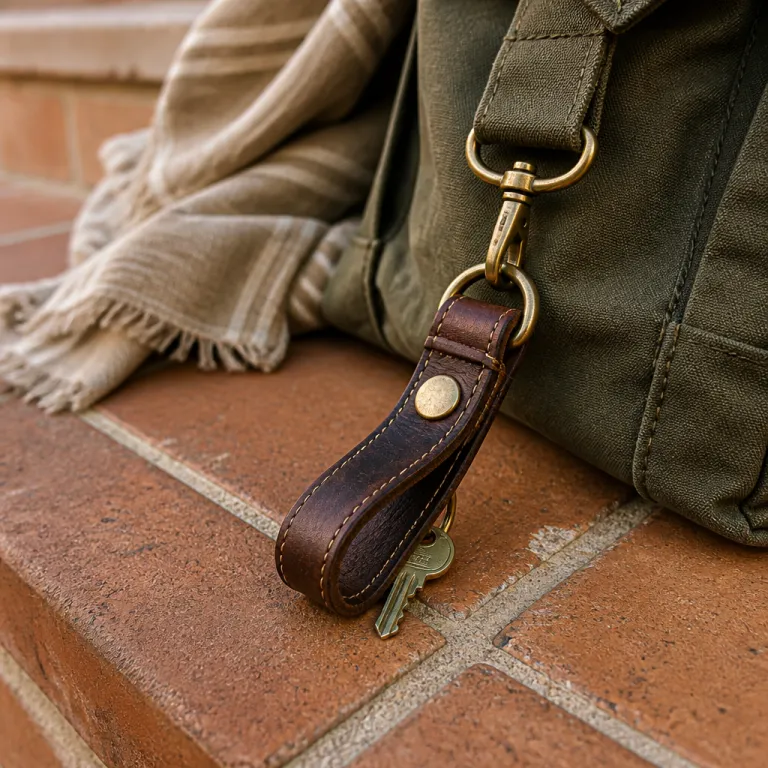
Why a leather key ring is a quiet statement of taste
A well made leather key ring says more about you than many louder accessories. When you choose premium leather for such a small key holder, you signal that craftsmanship matters even in the most regular details of daily life. A discreet keychain in full grain leather, paired with a solid brass split ring, turns a routine gesture into a refined ritual.
Owners of high end cars and apartments often underestimate how a leather keychain or a leather key fob frames the first contact with their key. The moment your hand reaches for that key ring, the softness of keychain leather and the weight of a solid brass loop keychain either elevate or diminish the experience. A carefully proportioned leather loop with a precise rectangle keychain profile keeps the silhouette slim while still feeling big enough to handle confidently.
For many collectors, a handmade leather key ring becomes the daily counterpart to a watch, wallet, and lanyard in the same material family. When the leather key matches the patina of your briefcase or key case, the ensemble feels intentional rather than improvised. In one well known British leather workshop, for example, a client requested a leather key holder dyed to echo the deep cognac tone of a decade old attaché case, turning a simple key ring into part of a coherent personal language.
Hardware integration on a leather key ring that respects your keys
The junction between leather and metal is where a leather key ring either excels or fails over time. A premium leather loop stitched around a solid brass split ring must distribute tension evenly, otherwise the leather key will stretch, crack, or twist under the weight of a big key bundle. When you evaluate leather keychains, look closely at how the loop keychain is folded, skived, and reinforced around the hardware.
Luxury owners who already appreciate a refined wallet chain understand why hardware geometry matters on a keyring. The same principles that guide a well balanced black tailor wallet chain apply to a leather keychain; the angle between the leather loop and the ring determines how keys lie flat in a pocket or hang cleanly from a belt. A rectangle keychain tab in premium leather, combined with a compact key fob ring, prevents keys from bunching into an uncomfortable mass.
High quality keyring leather should never be pierced randomly to attach a key holder or lanyard clip. Instead, the leather key ring must use carefully placed slots or rivets that avoid cutting across the grain structure of the leather. This attention to hardware integration ensures that even under regular use, with several keys and a key case attached, the keychain leather ages gracefully rather than failing at its weakest point.
Choosing leather, construction, and finish for lasting elegance
The leather itself defines how your leather key ring will age, darken, and respond to touch. Full grain vegetable tanned leather keychains develop a rich patina that mirrors the evolution of a premium leather watch box or a finely crafted key case. When you run your fingers along a leather loop, you should feel dense fibers and a smooth burnished edge, not a spongy or painted surface.
Construction details separate a regular keychain from a truly premium leather key holder that can accompany you for decades. Look for a rectangle keychain tab with clean saddle stitching, where each thread passes through the leather key in a consistent rhythm and the back of the keyring leather is as neat as the front. A handmade leather key ring with waxed thread and polished edges resists moisture and friction better than a mass produced keychain leather strip with raw, fuzzy sides.
Finish also influences how a leather keychain behaves in pockets, bags, or attached to a lanyard. A lightly waxed leather loop keychain slides easily against fabric and avoids catching on the lining of a key case or briefcase. When the split ring and solid brass hardware are proportioned correctly to the leather keychains, the entire key holder feels balanced rather than top heavy or flimsy.
Price, value, and how to read reviews for leather key rings
For luxury owners, the price of a leather key ring is less about affordability and more about whether the value aligns with your standards. A handmade leather keychain in premium leather with solid brass hardware will often sit in the 60 to 150 usd range, while ultra refined pieces from heritage maisons can exceed that regular price by a comfortable margin. These figures are based on typical pricing from brands such as Hermès, Louis Vuitton, and smaller European ateliers, and should be read as indicative workshop estimates rather than formal industry statistics.
Reading reviews for leather accessories requires a different lens when you already own high end bags and wallets. Focus on reviews leather specialists write about edge finishing, stitching regularity, and how the keyring leather behaves after months of use rather than on quick first impressions. When multiple reviews mention that the leather key or key holder has maintained its shape despite a big set of keys, you gain confidence that the leather keychains are engineered for real daily pressure.
Some brands in the USA position their leather key ring collections as entry points into their universe, using a lower sale price to attract new clients. As an existing luxury leather owner, you can treat these keychain leather pieces as test cases for the brand’s broader craftsmanship claims. If the smallest rectangle keychain or loop keychain fails under regular use, it raises questions about the same workshop’s ability to produce a long lasting wallet, lanyard, or key case.
From diy leather projects to bespoke handmade key holders
Many connoisseurs eventually explore diy leather work to better understand what makes a leather key ring exceptional. Working on a diy leather keychain or a simple leather loop at home reveals how challenging it is to cut a straight rectangle keychain blank, punch precise holes, and fit a split ring without distorting the grain. After a few diy attempts, the price of a professional handmade leather key holder suddenly feels more rational.
Bespoke artisans often start with a flat pattern that considers how the leather key will fold around the hardware and how the keyring leather will sit in the hand. They may offer options such as a wider loop keychain for a big key bundle, or a slimmer leather keychain leather strip designed to tuck into a compact key case. Some workshops in the USA even allow you to send an existing lanyard or key fob so they can match the leather, thread color, and solid brass finish for a perfectly coordinated set.
Custom makers also understand that a leather key ring is frequently chosen as a gift, whether as a corporate gesture or a personal token. They might include a free monogram, a matching leather key tag, or a small key holder case as part of a limited keychain sale. One Midwestern leather studio reports clients returning with the same leather keychain after many years of daily use, asking only for a fresh polish on the brass; in such cases, you are paying not just for premium leather and hardware but also for the expertise that keeps the loop, ring, and keychain leather working together harmoniously.
Practical elegance: carrying, pairing, and gifting your leather key ring
How you carry a leather key ring influences both comfort and longevity. A compact leather keychain attached to a short lanyard keeps keys accessible without letting a big key bundle swing wildly against delicate leather bags or polished car interiors. When you pair a leather loop keychain with a dedicated key case, you protect both the keyring leather and the contents of your pockets from scratches.
Thoughtful pairing extends to the rest of your everyday carry, especially if you already own high quality wallets and watch accessories. Matching the tone of your leather key to the grain and color of a long lasting wallet hinge or bill section creates a subtle visual harmony that connoisseurs immediately notice. A well chosen rectangle keychain in premium leather can echo the structure of a refined watch box, as explored in many discussions of craftsmanship and elegance in leather horology storage.
As a gift, a leather key ring occupies a rare space between practicality and sentiment. The recipient uses the leather keychain daily, yet the object remains small enough to feel intimate, especially when the key holder includes a discreet engraving or a free personalized note. When you select such leather keychains, consider whether the keychain leather, split ring, and solid brass details reflect the same standards you apply to your own lanyard, key fob, and key case.
Key figures and market insights for luxury leather key rings
- Industry commentary on small leather goods suggests that keychains and key holders typically represent a modest but meaningful share of a luxury brand’s leather accessories revenue, indicating that the leather key ring is a carefully curated category rather than a mass commodity; this view is echoed in reports from firms such as Bain & Company and McKinsey that discuss the role of entry level leather goods.
- Price positioning across well known European maisons shows that a premium leather keychain often starts around 80 usd and can exceed 250 usd for limited editions, which broadly aligns the regular price of a key holder with the lower end of small leather wallets, though exact figures vary by house and season; current collections from brands like Hermès, Gucci, and Louis Vuitton illustrate this range.
- Customer feedback gathered by brands in the luxury segment frequently indicates that products such as leather key rings and key cases achieve high repeat purchase and gift recommendation rates, because they combine relatively accessible price points with daily usability; these observations are directional rather than a single standardized statistic.
- Analysts tracking the USA luxury accessories market have noted that handmade and artisanal leather keychains are steadily gaining visibility within the keychain sale segment, reflecting a gradual shift toward craftsmanship and away from purely logo driven designs, even if precise percentages differ between reports.
FAQ about luxury leather key rings
How should I care for a premium leather key ring used every day ?
Wipe your leather key ring with a soft dry cloth weekly to remove dust and metal residue from keys. Every few months, apply a small amount of neutral leather conditioner to the leather key and leather loop, avoiding the split ring and solid brass hardware. Let it dry away from direct heat, and never over saturate the keychain leather, as excess product can weaken stitching; many owners use a light cream similar to those recommended for high end leather bags.
Is a solid brass split ring better than plated hardware for keychains ?
Solid brass hardware on a leather keychain offers superior resistance to corrosion and tends to age with an attractive patina that complements premium leather. Plated rings can chip or peel under regular friction from keys, which then exposes base metal that may stain keyring leather. For a long term key holder or key case, solid brass is usually the more durable and elegant choice.
What thickness of leather is ideal for a handmade key holder ?
For a leather key ring, many artisans choose leather between 2 and 2.5 millimetres thick, which balances flexibility and strength. Thinner leather may stretch around the split ring, while thicker cuts can make a rectangle keychain or loop keychain feel bulky in a pocket. The right thickness allows the leather key to fold cleanly around hardware without creating a big, uncomfortable mass.
Are diy leather keychains a good way to learn about craftsmanship ?
Working on a diy leather keychain or simple leather loop is an excellent way to understand the skills behind premium leather goods. Cutting straight lines, punching holes for a split ring, and finishing edges on a small key holder quickly reveal how much precision is required. After such diy projects, many owners better appreciate the price and reviews of professional handmade leather keychains.
How can I judge value when a leather key ring is on sale ?
When you see a leather key ring offered at a sale price, compare it to the listed regular price and examine whether materials and construction match your expectations for premium leather. Check reviews leather specialists have written about stitching, edge finishing, and hardware quality rather than focusing only on the discount percentage. A well made leather keychain on keychain sale can be excellent value, but a poorly built key holder remains expensive even at a reduced usd figure.