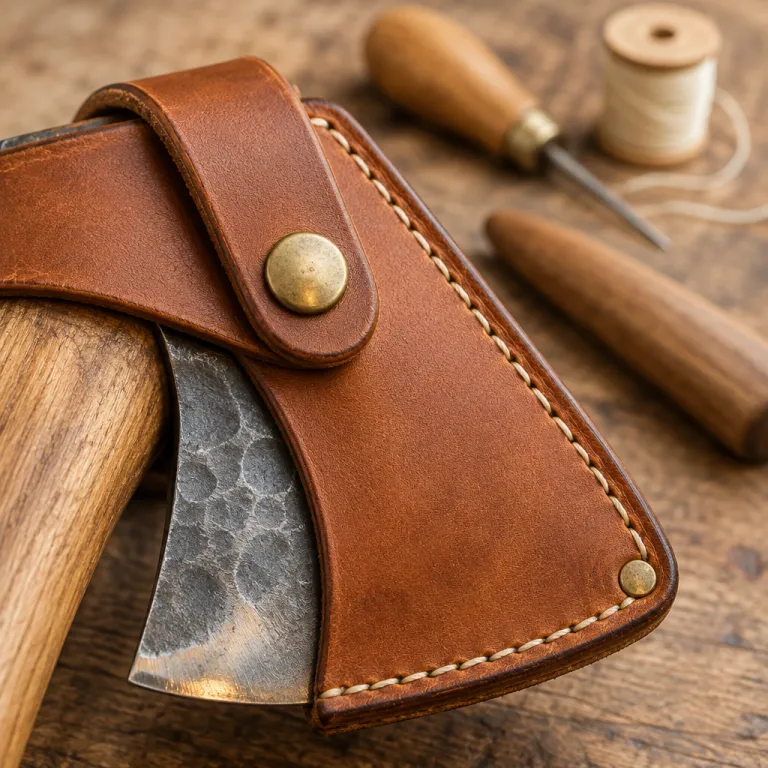
When a leather axe sheath becomes a piece of fine equipment
A well made leather axe sheath turns a simple axe into a refined companion. When the leather is carefully selected and the sheath is tailored to a specific axe model, the result feels closer to a bespoke shoe than a generic axe cover. This is where premium leather choices, precise cutting, and disciplined stitching elevate a humble tool into something worthy of a luxury collection.
For owners of high grade tools, the sheath will often say as much about taste as the polished axe head itself. A sheath crafted from dense vegetable tanned leather, with a subtle edge bevel finish, frames the cutting edge like a bezel frames a watch dial. When several leather sheaths are displayed together, the way they protect edge lines and echo the curve of each handle creates a quiet, architectural rhythm on the wall, a visual order that collectors recognise from carefully arranged shelves of structured bags or watch rolls.
Luxury collectors rarely accept a price explanation without understanding the craft behind it. They want to know why one leather sheath commands a higher cost per unit than another that appears similar at first glance. The answer lies in the quality of tanned leather, the accuracy of every stitch, and the way the sheath will age as gracefully as a structured leather bag in a curated wardrobe, a behaviour documented in long term wear tests by specialist vegetable tanneries such as Horween, J&FJ Baker, and Badalassi Carlo.
Choosing leather and structure to protect edge and aesthetics
The starting point for any serious leather axe sheath is the hide itself. Full grain vegetable tanned leather in the 3.5 to 4 millimetre range offers enough rigidity to protect edge geometry while still molding subtly around the axe head. When several sheaths are lined up, you can immediately see which ones used consistent edge leather thickness and which ones compromised structure for cost, because the weaker pieces twist, sag, or show early seam distortion.
Collectors who already appreciate structured bags will recognise the same design logic here. Just as a frame bag maintains its silhouette over time, a well boned leather sheath keeps the axe head stable and prevents the cutting edge from biting through the seams, a principle explored in depth in this analysis of why structured leather pieces outlast slouchy designs. When the sheath will be used outdoors, the balance between rigidity and flex becomes even more critical, because repeated impacts and moisture test every decision the maker has taken, from welt thickness to the density of the stitching.
Inside the workshop, the maker evaluates each section of tanned leather for density, fibre direction, and surface character. A regular piece might be reserved for small accessories, while the best areas are cut for the main body of leather sheaths that must carry weight and absorb shocks. This disciplined selection is why the final price of a sheath that truly protects an axe often feels closer to fine luggage than to hardware store gear, and why bespoke makers frequently discard 30 to 40 percent of a hide that does not meet their standards.
Innovative hand tools and techniques behind refined leather sheaths
Behind every elegant leather axe sheath lies a bench scattered with deceptively simple tools. The maker reaches for a stitch groover to cut a straight channel that sinks the stitching slightly below the surface, which helps protect threads from abrasion when the axe is drawn or reinserted. A sharp edge beveler then softens the perimeter of the sheath, giving the leather a tactile contour that feels deliberate in the hand and reduces the risk of the edge leather catching on clothing or other gear.
Cutting the pattern for different axe models demands more than a utility knife and a ruler. Many artisans now rely on a strap cutter to produce consistent straps for closure systems, then refine the curves around the axe head with small French skiving knives that reduce bulk without weakening the structure, a process that echoes the careful thinning of leather in high end briefcases featured in this review of work ready leather pieces. A common example is a compact forest axe with a 90 millimetre cutting edge and a 500 gram head, which may require a tighter welt and deeper throat than a broad hatchet; when the leather sheath is destined for a collector, the maker will often test fit the axe repeatedly, adjusting the cutting lines by fractions of a millimetre until the handle seats with a quiet, confident stop.
Stitching is where innovation and tradition meet most visibly. Many contemporary artisans pair a classic awl with modern ritza tiger polyester cord, often called tiger thread, because it combines a crisp profile with impressive resistance to moisture and abrasion, and this tiger thread or ritza tiger thread can be used in both straight runs and tight curves without fraying. The result is a row of stitches that reads as a design element while working hard to keep the sheath intact under the weight and movement of serious tools, a detail often highlighted in case studies of long term field use by Scandinavian axe makers and North American custom leather shops.
Balancing regular price, unit price, and long term value
Owners of luxury leather goods are already accustomed to evaluating value beyond the initial price tag. The same mindset applies when assessing the regular price of a leather axe sheath, because the unit price is best understood as the cost of one finished sheath divided by the years of service it will provide, not just the first season of use. When a sheath will protect edge geometry and the finish of a rare axe model, the cost of failure quickly outweighs any saving made at purchase, especially if a damaged head must be reground or replaced.
Consider the difference between a mass produced sheath and a bespoke piece made from carefully selected vegetable tanned leather. The first may offer an attractive price per unit on paper, but if the stitching fails or the fit allows the cutting edge to rattle against the interior, the axe head can suffer micro chipping that permanently alters performance, while a well executed sheath will stabilise the handle, cradle the head, and protect edge alignment through repeated impacts. Over a decade, the amortised unit price of the better sheath often becomes negligible compared with the preservation of both function and resale value, and many custom makers now quote typical ranges of 120 to 300 units of local currency for a fully hand stitched, model specific sheath.
Collectors who commission multiple leather sheaths for different tools often track their acquisitions as they would a small portfolio. They note how each sheath will age, how the tanned leather patinates, and how the regular price compares to other luxury accessories in their wardrobe, from belts to structured bags. In this context, a high calibre leather axe sheath sits comfortably alongside a refined wallet or a travel case, because it reflects the same insistence on durability, repairability, and quiet visual harmony, and because a well documented service history can support higher resale values for both axe and sheath.
Integrating the leather axe sheath into a coherent luxury toolkit
For many enthusiasts, the axe is no longer just a rough tool but part of a curated lifestyle ensemble. A carefully specified leather axe sheath allows the axe to sit alongside a trucker wallet, a briefcase, or a weekender bag without visual discord, especially when the same family of vegetable tanned leather and edge leather treatments is used across pieces. This is why some collectors work with a single atelier to create both their sheaths and their small leather goods, aligning colour, finish, and hardware for a unified aesthetic that extends from wardrobe to workshop.
Hardware choices on the sheath handle strap or retention system deserve the same scrutiny as the metalwork on a wallet chain. Understated brass or stainless steel components echo the refined hardware philosophy explored in this perspective on why considered metal details matter in modern leather wardrobes. When the sheath will be hung in an entrance hall or displayed in a cabin, these details ensure the axe reads as an intentional design object rather than a stray tool, and thoughtful makers now specify hardware tested to outdoor standards similar to those used on technical luggage.
Function remains central even in a luxury context. The leather sheath must allow a secure grip on the handle, keep the cutting edge fully covered, and withstand the occasional knock from a hammer or contact with other tools without transferring marks to the axe head, and when several leather sheaths are stored together, their consistent dimensions and straight seams create a sense of order that many collectors find deeply satisfying. In this way, the leather axe sheath becomes both a protective layer and a visual anchor in a broader ecosystem of finely made objects, a role often highlighted in brand lookbooks that pair outdoor tools with city ready leather accessories.
From workshop to woods: using and maintaining refined sheaths axes
Once a leather axe sheath leaves the bench, its real story begins. Regular use in the field tests every decision the maker has taken, from the depth of the stitch groover channel to the choice of tiger thread or ritza tiger thread for stitching exposed areas, and over time the sheath will either confirm its status as a luxury object or reveal shortcuts that a discerning owner will not forgive. A well designed sheath will protect edge integrity even when the axe is carried against other tools, leaned against rough timber, or dropped onto the floor of a vehicle.
Maintenance rituals for high end leather sheaths mirror those for fine bags and wallets. Light cleaning, careful drying, and occasional conditioning keep the vegetable tanned leather supple while preserving the crispness of the edge bevel work and the straight lines around the axe head, and owners quickly learn how a small amount of attention prevents the leather from drying or cracking. When a sheath will see heavy seasonal use, some collectors even rotate between several sheaths, allowing each unit to rest and recover its shape fully, a practice often recommended in guides to vegetable tanned axe sheath care.
A simple care checklist for a vegetable tanned sheath or tool cover might include: wiping away dirt after each trip, drying slowly at room temperature, conditioning sparingly two or three times a year, checking stitching around stress points, and storing the axe where the sheath is not crushed or exposed to direct heat.
Thoughtful storage completes the cycle. Hanging the axe by its handle with the leather sheath fully enclosing the cutting edge prevents accidental contact with other tools and protects both the blade and nearby surfaces, while laying the axe flat on a shelf with the sheath supporting the head avoids pressure points that could deform the leather over time. In this way, the leather axe sheath proves its worth not only as a beautiful object but as a disciplined guardian of performance, safety, and long term value, a conclusion echoed in occupational safety guidance that emphasises reliable blade covers.
Key figures and market insights for luxury leather axe sheaths
- Specialist tanneries report that high quality vegetable tanned leather often costs several times more than mass market chrome tanned alternatives, which significantly influences the regular price and unit price of any leather axe sheath made from premium hides. Industry interviews with European and Japanese tanneries commonly cite raw material cost differences of 200 to 400 percent for top grade shoulders and bends.
- Industry case studies on vegetable tanned leather products suggest that, when properly maintained, they can retain functional integrity for decades, meaning that a higher initial price per unit for a sheath that will protect edge geometry is often offset by long service life. Field reports from heritage brands show belts, bags, and tool covers still in service after 20 to 30 years of regular use.
- Market research firms tracking the global luxury leather goods segment have noted steady annual growth in recent years, and specialist accessories such as leather sheaths and tool covers are benefiting from this trend as collectors extend their interest beyond bags and wallets. Several reports now list outdoor inspired small goods as one of the fastest growing subcategories.
- Occupational safety guidance consistently highlights that proper blade protection can substantially reduce accidental cutting injuries in professional environments, underscoring the practical value of a well designed sheath that fully covers the axe head and cutting edge. Studies of workshop incidents repeatedly identify exposed blades and improvised covers as avoidable risk factors.
FAQ about luxury leather axe sheaths
What type of leather is best for a high end axe sheath ?
For a luxury leather axe sheath, full grain vegetable tanned leather between 3.5 and 4 millimetres thick offers the best balance of rigidity, moldability, and long term durability. This type of tanned leather develops a rich patina while maintaining enough structure to protect edge geometry and resist cutting from the blade. Chrome tanned options can be used for accents, but they rarely match the longevity and repairability of dense vegetable tanned hides.
How should a leather sheath fit the axe head and handle ?
A proper fit means the axe head seats fully without excessive play, while the cutting edge remains completely covered by the sheath. The handle should pass through any strap or retention system without forcing, yet the sheath will stay in place when the axe is carried or inverted. If the sheath feels loose or allows the blade to rattle, it can damage both the leather and the edge over time.
Why do some leather axe sheaths cost significantly more than others ?
Higher prices usually reflect better raw materials, more precise cutting and stitching, and additional hand finishing steps such as edge bevel work and burnishing. Makers who use premium vegetable tanned leather, ritza tiger thread, and carefully calibrated stitch groover channels spend more time on each unit, which raises the regular price and unit price but also extends the sheath’s service life. In many cases, the cost of repairing or replacing a damaged axe head far exceeds the difference between an entry level and a high end sheath.
How can I maintain my leather axe sheath in harsh outdoor conditions ?
After exposure to moisture, wipe the sheath with a dry cloth and allow it to air dry away from direct heat, then apply a light conditioner suitable for vegetable tanned leather. Regular inspection of the stitching, especially around the axe head and along straight stress lines, helps you address any issues before they compromise the ability to protect edge integrity. Storing the axe in a cool, ventilated space when not in use will also slow down premature aging of both leather and thread, and following a simple vegetable tanned axe sheath care routine can add years of reliable service.
Can a leather sheath be repaired or adjusted for a different axe model ?
Minor repairs such as restitching seams, replacing a strap cutter made closure, or reinforcing the area around the cutting edge are usually straightforward for a skilled leatherworker. Adjusting a sheath to fit a different axe model is more complex, because the geometry of the head and handle may differ enough to require recutting and restitching large sections. In many luxury contexts, commissioning a new sheath tailored precisely to the new axe offers a better long term result than heavily modifying an existing piece.
